With academic events, a gathering of wind bands, a rock concert, and folk dancing, indigenous peoples celebrated the “International Day of the World’s Indigenous Peoples” in Chilpancingo and Chilapa de Álvarez.
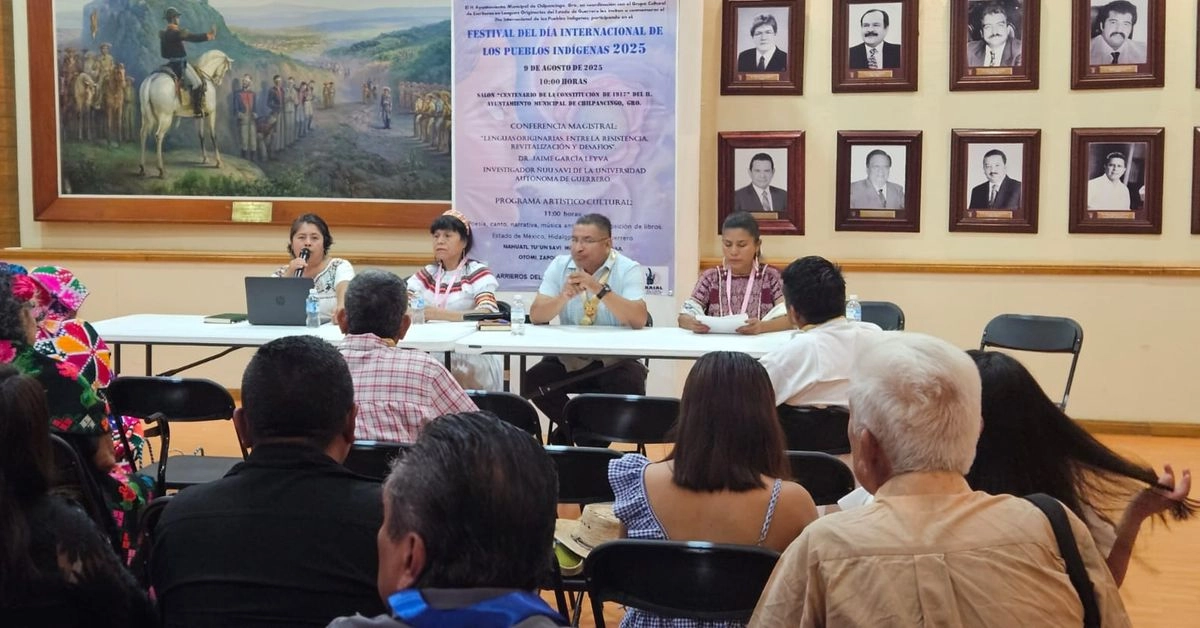
In Chilpancingo, Jaime García Leyva, a researcher from the Autonomous University of Guerrero, proposed rescuing the values and principles of indigenous peoples, “so that even if you are in Harlem, New York; in Chicago; or in Iguala; or here in Chilpancingo, in Colonia Emperador, you have to go see your dead, even though the words “respect,” “honor,” and “pride” unfortunately come from an external culture, which is breaking with the social fabric. But from within and without, we have to strengthen and examine these processes, and above all, respect them. The challenge is to generate linguistic cultural policies; studies; and precise, contextual diagnoses, and to influence or ensure that these cultural elements are present in schools; in the media; and in public spaces.”
García Leyva gave a keynote address at the municipal palace in this capital, where he stated: “Here in Mexico, the names of towns are in Spanish. There are few places that, even with an indigenous population, have names in Spanish. Few have them in an indigenous language, or in a foreign language, as is the case in Oaxaca. Here you arrive in Chilapa, and it’s called Chilapa, but in Nahuatl it has another name; and in Tu’un Savi (Mixtec), it also has another name.”
We must “build language policies at various levels; the first has to do with the national structure; the second, with the state; and the third, with the local spaces, where we must have an impact. We’re not going to leave everything to the authorities either. Daily, personal actions are what speak volumes. Today, young people involved in digital activism are writing their rap in Tu’un Savi, or Nahuatl; and even their emails are written in indigenous languages; their t-shirts, and a series of elements that are revitalizing them.”
It has nothing to do “with the construction of a public policy that goes more in a constructive direction, in the creation of content, discussion, and analysis, of the role that the linguistic development committees, Me’phaa, Tu ún Savi, are playing in the study of spellings, lexicology, and grammar, which is important.”
In this part: to what extent do we, as individuals, want to be bilingual, in an indigenous language? Not bilingual in English or French, which they have in universities? Why not also be bilingual in Me’pha, Tu’un Savi, Nahuatl, or Ñomnda? Another challenge is recovering this identity that has been lost.
Another part has to do with “the national legal framework, which must be promoted and revitalized; and local legal frameworks such as the local Congress, and the good government groups and police forces in the municipalities. We need to see what the councilors of culture and education are doing; subjects we voted for and put there, so they can take over public policies.”
We are losing, “culture is being rationalized, transformed; we are also losing our own cultural elements. The use of the media—posters, billboards, radio, and the press—also needs to promote oral and written communication.”
Everything has to do with the budget: who bells the cat? “How much is invested in education, in projects? There are many poets, musicians, writers, and people who create culture in Guerrero; but there’s no budget. We need to forge alliances with the university sector, academics, businesspeople, and people who create culture; that’s what we have to build in the future.”
We need to revitalize our indigenous languages, “above all, dignify them; they are no longer dialects, they are languages. They are not the language of the poor, of the indigenous people; they are not languages that have no value, but rather they have great value; a profound historical process in which we are immersed.”
“We have to seek to connect, create networks, communicate, share experiences; find out what our colleagues from Alto Balsas, La Montaña, and the Costa Chica are doing. “We have a task: to write our own history,” he concluded.
Yesterday afternoon, in the municipality of Chilapa de Álvarez, the Nahuatl indigenous people celebrated their day to the rhythm of the tambora, tubas, and snare drums, and later with rock music. The celebration began with the first gathering of traditional wind bands (also known as fried chile), from Nahuatl indigenous communities in this municipality, located in the Lower Mountains of Guerrero.
A jury comprised of music teachers Víctor Adrián Zúñiga Cortez and Jesús Gerónimo was formed. At 11:00 a.m., the wind bands lined up around the stage, which was set up in the Adolfo López Mateo public plaza, before some 200 attendees, who danced nonstop. At the end, the jury announced its verdict in favor of the band Cielo Azul from Calhuaxtiltlán, which won a cash prize of 30,000 pesos; second place went to the band La Concepción from the town of Ocuituco, with 20,000 pesos; and third place went to the band Retoños from San Ángel, with 10,000 pesos. Five thousand pesos were also awarded to the losing bands in this competition to rescue the traditional music of the Nahua peoples of this region marked by violence, which concluded with a musical ensemble featuring all the bands. who performed El Querreque and La Malagueña at the same time.
But in Chilapa, new generations of indigenous youth, who migrate to various cities in the country or abroad, were also able to enjoy a rock concert, with banas (people from Tlapa) performing songs in Nahuatl, Spanish, and English; this was also part of the ninth day of activities for Chilapa’s Tigrada 2025.
Starting at five in the afternoon, in the heart of Chilapa, where the Catholic faith and conservative families predominate, dozens of young people, teenagers, adults, seniors, and even children arrived for the concert, billed as the first gathering of rock bands and rockers of Chilapa 2025. Eight local bands participated, paying tribute to the band La Montaña, originally from Tlapa and founded in 1969. The concert began with the band Inocente Inocencia, singing in Nahuatl; Next up was the band Víctor Sideral, with its soloist Jules; then it was the legendary band La Montaña’s turn, playing everything from rock, country, metal, rock and roll, and blues.
Source: jornada